

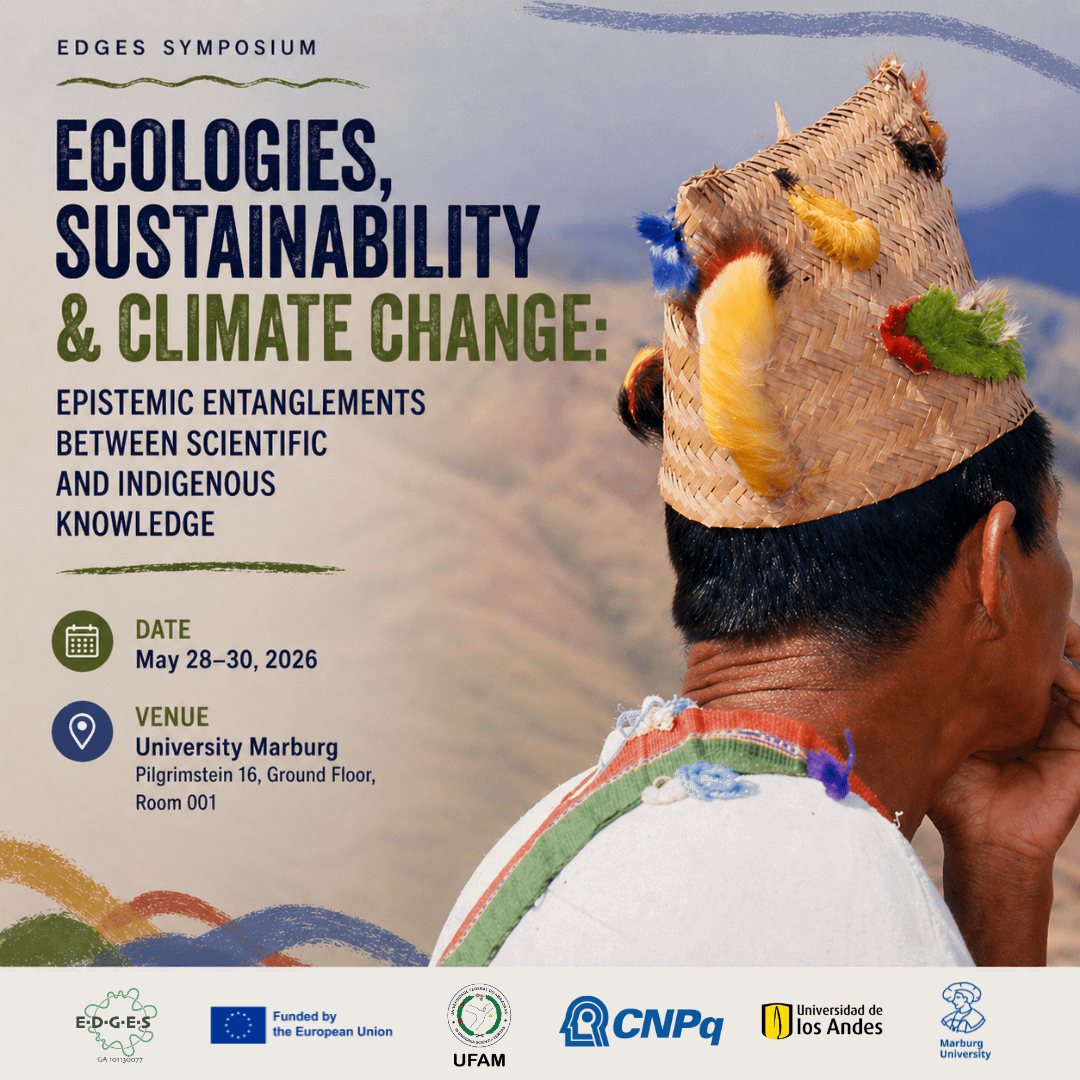
Ecologías, sostenibilidad y cambio climático: entrelazamientos epistémicos entre conocimientos científicos y indígenas · Ecologias, sustentabilidade e mudança climática: entrelaçamentos epistêmicos entre conhecimentos científicos e indígenas
28-30 May 2026
University of Marburg, Germany
Pilgrimstein 16, Ground Floor, Room 001
ABOUT
This symposium, part of the EDGES project (Work Package 4), examines the relationships, interconnections, and frictions between scientific and indigenous knowledge systems. Moving beyond noting mere similarities or incommensurabilities, it explores cosmo-ecologies, inter-epistemic dialogue, collaborative research practices, and possibilities for cooperation in confronting contemporary environmental crises. The event advances a pluralistic and symmetrical epistemological framework toward a sustainable future and a just ecological transition.
VENUE
Department for Social Anthropology and the Study of Religions · Pilgrimstein 16, Ground Floor, Room 001 · University of Marburg, Germany
PROGRAMME
Day I — Cosmo-Ecologies, Territory, Practices
Thursday, 28 May
10:00 — Session 1: Cosmo-Ecologies
From Ecological Cosmologies to Cosmo-Ecologies: Lessons from the Isthmo-Colombian Region
Juan Camilo Niño Vargas (Universidad de los Andes)
Acordos: relações entre humanos e Waí Manhãs [Agreements: Relationships Between Human and Waí Mahsã]
Rosijane Fernandes Moura – Tukano (Universidade Federal do Amazonas)
11:30 — Session 2: Cosmo-Ecologies (cont.)
O Atlântico Indígena: múltiplos e confluências na paisagem vivida pelos Tupinambá de Olivença (Brasil) [The Indigenous Atlantic: Multifacets and Convergences in the Landscape Lived by the Tupinambá of Olivença (Brazil)]
Susana de Matos Viegas (Universidade de Lisboa)
Holistic and Realist Knowledge Exchange with Indigenous People
Falk Parra Witte (Universität of Hildesheim)
14:30 — Session 3: Territory, Security & Health
Disputing the primacy of knowledge about the world: uneven onto-epistemic regimes in state-Indigenous relations
Andrés G. Dinamarca (University of Oxford)
Vigilancia ambiental comunitaria en la Amazonía: interdependencias, conocimientos y responsabilidad [Community-based environmental monitoring in the Amazon: interdependencies, knowledge, and responsibility]
Jonas Bauschert (Ludwig-Maximilians-Universität München)
Amazonian Cosmo-Ecologies and COVID-19 in Peru: Indigenous Explanations of the Pandemic’s Origins in dialogue with Western Biomedicine
Jorge Luis Lossio Chávez (Pontificia Universidad Católica del Perú)
16:30 — Session 4: Practices and Objects
Entre caminhos e lagos: percepção ambiental e habilidades de pescadores Kaixana [Between paths and lakes: environmental perception and the skills of Kaixana fishermen]
Darlem Teixeira Penaforth – Kaixana (Universidade Federal do Amazonas)
Mineralidades Pupỹkary: a ciência de mulheres indígenas no fazer cerâmica [Pupỹkary Mineralities: The Science of Indigenous Women in Pottery-Making]
Elaine Cristina Guedes Wanderley – Parintintin (Universidade Federal do Amazonas)
The role of machines in modern ecologies
Theodor Borrmann (University of Oxford)
Day II — Water, Climate, Rights & Agroecology
Friday, 29 May
09:30 — Session 1: Water, Winds and Climate
Placing water in the landscape: hydraulic ritual, management and technology in the Andes
Alexander Herrera (Universidad de los Andes)
Wind and Waters, Páramo Weather and Ecological Anthropology: Engaging inter-epistemic Dialogues in Southwest Andes, Colombia
Mónica L. Espinosa Arango (Universidad de los Andes)
Oscilaciones ontológicas del agua en la Línea Negra: Etnografía de encuentros interepistémicos en la Sierra Nevada de Santa Marta [Ontological Oscillations of Water at the Línea Negra: An Ethnography of Inter-Epistemic Encounters in the Sierra Nevada de Santa Marta]
Lorena Aja Eslava (Universidad del Magdalena)
11:30 — Session 2: Water, Winds and Climate | Good Life
The Equivocal Atmosphere: Between Carbon Cycles and Cosmo-Meteorological Transformations
Ernst Halbmayer (Philipps-Universität Marburg)
El concepto de “vivir bien” en la memoria de los kallawayas del norte de La Paz y su situación a inicios del siglo XXI [The concept of “living well” in the memory of the Kallawayas of northern La Paz and their situation at the beginning of the 21st century]
María Luisa Soux (Universidad Mayor de San Andrés)
14:30 — Session 3: Rights | Agro-Cosmoecology
Entangling Local Expertise within Institutional Frameworks: Reflections on the Rights of Nature’s Peritos in Ecuador
Karla Garcia (Ludwig-Maximilians-Universität München)
Entrecorazonamiento epistémico jurídico desde la Selva Viviente (Kawsak Sacha) [Epistemological legal heart-thinking entanglements in the production and thought from the Living Forest (Kawsak Sacha)]
Mario Yaucén Remache – Kiíchwa & Jenny García Ruales (Philipps-Universität Marburg)
Agroecología para la vida y gobierno propio: Agencia política de las mujeres Wintukwas. Un estudio decolonial en el pueblo Wintukwa [Agroecology for Life and Self-Governance: The Political Agency of Wintukwa Women Through the Law of Origin. A Decolonial Study of the Wintukwa People]
Yeimy Alejandra Izquierdo Cujar – Wintukwa (Universidad de los Andes)
16:30 — Session 4: Agro-Cosmoecology | Contemporary value chains
Capoeiras epistemológicas — produções de conhecimentos, sustentabilidades e mudanças climáticas, Alto Rio Negro/AM [Epistemological capoeiras-knowledge production, sustainability, and climate change, Upper Rio Negro/AM]
Silvio Sanches Barreto – Bará (Universidade Federal do Amazonas)
The Intersectional Perspective of Value: Power Relations and Knowledge in Coffee Value Chains
Tatiana Giraldo Liévano (Universität für Bodenkultur Wien)
Contactos preinkas entre poblaciones y ecosistemas de Tierras Altas y Tierras Bajas [Pre-Inca contacts between populations and ecosystems of the Andes and the Amazon]
Jédu Sagárnaga (Universidad Mayor de San Andrés)
Day III — Sustainabilities, Friendship and Secrecy
Saturday, 30 May
09:30 — Session 1: Sustainabilities and Recoveries
Simbiopolítica dos refúgios: alianças multiespécies em territórios indígenas do Brasil [Symbiopolitics of sanctuaries: some stories about multispecies alliances in indigenous territories in Brazil]
Thiago Mota Cardoso (Universidade Federal do Amazonas)
Resurrections of Harakbut Cosmo-ecological FormationsResurrections of Harakbut Cosmo-ecological Formations
Alessio Thomasberger (Philipps-Universität Marburg)
Interculturalidad y sistema escolar en el Pueblo Originario Kíchwa de Sarayaku para asegurar la defensa del territorio y la vida. [Interculturalism and the school system among the Sarayaku Kíchwa Indigenous People to ensure the protection of the territory and life]
Mario Yaucén Remache – Kíchwa Sarayaku & Myrian Mariana Gualinga Aranda – Kíchwa Sarayaku
11:30 — Session 2: Friendship, Secrecy and Sacredness
Human-plant friendship? Affective encounters and agroforestry reforestation in the Caititu Indigenous Land, Brazilian Amazonia
Markus Enk (Université libre de Bruxelles)
O Tempo Profundo dos Territórios Apurinã, através dos Lugares Sagrados e os Desafios para sua Proteção [The Deep History of the Apurinã Territories, Through Sacred Sites and the Challenges of Protecting Them]
Pirjo Kristiina Virtanen & Francisco Apurinã (University of Helsinki)
Vital Opacity for the Time of Sharing – Huni Kuin Music between Academic Transparency and Shamanic Secrecy
Felix Uhl (Frobenius Institut Frankfurt)
ORGANIZERS
Ernst Halbmayer
Philipps-Universität Marburg
Juan Camilo Niño Vargas
Universidad de los Andes
Thiago Motta Cardoso
Univ. Federal do Amazonas
*Hosted by the Dept. for Social Anthropology and the Study of Religions, Universität Marburg * Part of the EDGES project (GA 10113007 7), funded by the European Union * In collaboration with Universidad de los Andes & Universidade Federal do Amazonas